One-day course – level 1 – 3,5h – Price: 2500 SEK
Learn the basics in kitesurfing and practise boardstarts. The following elements are included in the 1 day course:


Learn the basics in kitesurfing and practise boardstarts. The following elements are included in the 1 day course:
Weather and wind are the two main components needed for kitesurfing, but there are many other things to consider before launching the kite into the sky. Trees, houses, hills, and other objects on land can cause turbulence, and too often negligent kitesurfers without sufficient knowledge have experienced unwanted flights in the air that ended badly.

Spotcheck involves an assessment of the location where you are going to kitesurf to detect possible risks and to ensure that the spot is safe for kitesurfing both on land and in the water.
A trainer kite is a small kite that we use to learn how to pilot the kite in the sky before we move on to the real kites. The principle of a training kite and a real kite is the same, but the training kite is considerably smaller and it will not break when you plunge it straight down in the ground, or in other words a perfect toy for practicing piloting until you can make a safe transition to a large kite. The video below shows how to fly a training kite.
The lesson with the trainer kite involves rigging a training kite, learn to manage its security features and of course learn how to pilot the trainer kite in a good way.
 When you’re kitesurfing and when it’s windy it’s usually very hard to hear what people say even if they yell at you, fortunately there are some international hand signals that kitesurfers use to communicate with each other.
At Gusty, you will learn the most important signals and you will be aware that they often come out to be very handy. The girl on the picture shows the sign for “I want to land my kite”. So when’re done kiting and want to land your kite, simply do the land-my-kite-sign and get someones attention. Hopefully there will be someone there to help you right away. Handy when it’s windy!
At first glance, a kite might seem complicated with all its lines, knots, struts, etc., and figuring out how to assemble everything on your own is no easy task. At Gusty, you receive a thorough walkthrough of the kite’s construction and the purpose of its various parts, and of course, you will learn to assemble and disassemble the kite with all the lines connected to the bar.
The control bar itself contains a variety of parts, and it is important to know what they are for and how to use them correctly. However, after a course with Gusty, this will no longer seem complicated.
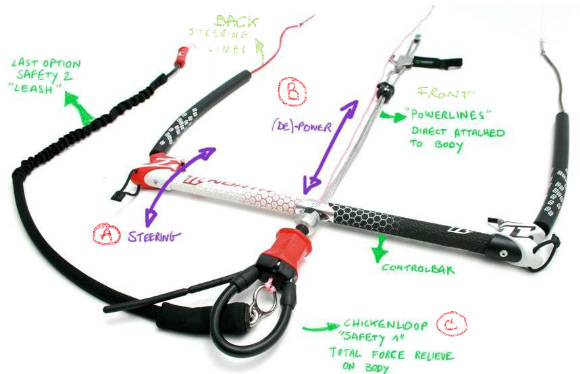
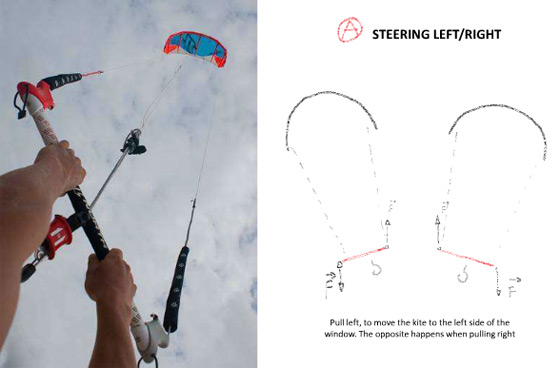
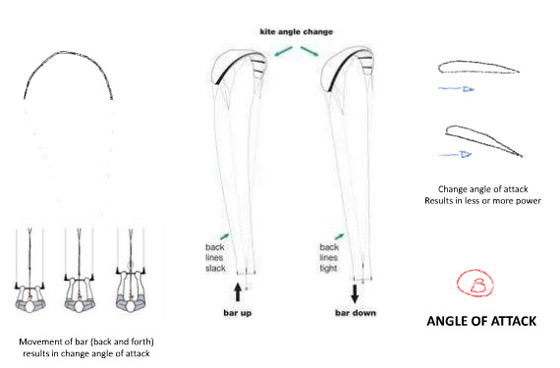
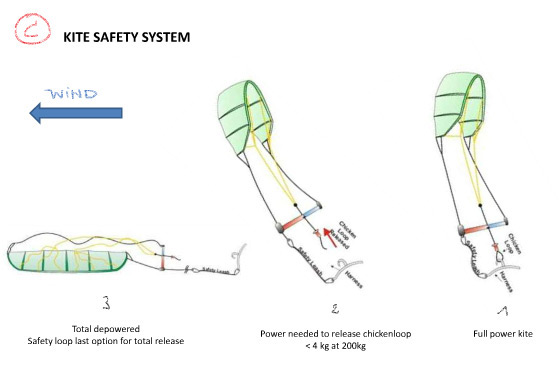
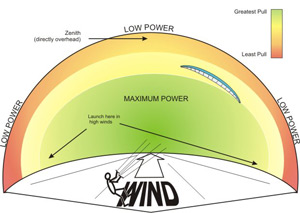
Click A, B, or C for a quick lesson in wind theory and flight mechanics; always good to not arrive completely unprepared for a kite lesson 🙂


Although you will learn to kite in safe conditions, unexpected situations sometimes arise where the kite becomes difficult to handle, e.g., if a sudden gust of wind grabs the kite or tangled lines make it unmanageable. Fortunately, all modern kites are equipped with safety systems, and these can be activated in an emergency. You can compare a kite’s safety system to life insurance; you prefer not to use it, but sometimes you are forced to. Unfortunately, it is not uncommon for kiters to completely neglect learning how to use the safety systems, as they are used so rarely. However, those who have learned the systems are thankful when they do end up in a dangerous situation. An instructor has a certain responsibility for you as a student, which is why we always do a thorough review of the kite’s safety systems before we move on to exercises in the water.
Aerodynamics
Part of safety involves having a certain understanding of aerodynamics, i.e., how the wind affects the kite and how you can regulate the power in the kite. When you have learned to tame the wind’s power, you have gained a lot regarding your own and others’ safety; after a Level 1 course, you will know how to do it 🙂
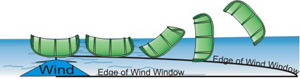
This step involves learning to explore the so-called wind window. Depending on how you steer the kite and where you place it in the wind window, you can generate the power required to be pulled by the kite. By steering and controlling the kite correctly, you can adjust the power and, if necessary, make the kite completely powerless. In conjunction with this step, you will also learn to handle the important safety systems.
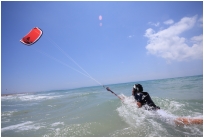
Bodydrag involves using the power of the kite to be pulled through the water. The purpose of this exercise is to get a feel for the potential power that a kite can generate. We start by body dragging downwind, and then go through the technique for body dragging upwind, which is important for, for example, retrieving a board you have lost behind you.
Our most popular course! During this two-day course, you will of course learn everything included in a full-day course, but we have more time to practice the key elements to make you safer and more comfortable handling the kite. On day 2, we focus more on board starts, and you will get to do several runs with the board in both directions. During this two-day course, we lay the foundation for you to be able to continue kitesurfing on your own.
One of the steps in level 2 is to be able to launch and land the kite safely. During the kite course, you will get to practice both landing and launching the kite several times.
All theory is done and you feel comfortable managing the kite, time to get the board! The absolute last step before you can call yourself a kitesurfer is getting up on the board with the help of the kite’s power. Not entirely easy and count on a fair amount of trial and error. Once you clear this hurdle, a completely new world opens up that you will never get enough of!
/Gustav – IKO licensed kitesurfing instructor
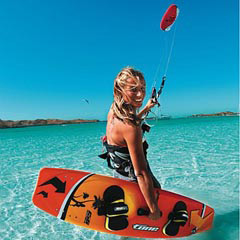
You can surely figure out what self-rescue means. It is something that rarely needs to be performed, but it is important to know in case of an accident out in deep water. During this exercise, you will learn how to perform a self-rescue, which basically involves regaining control of a crashed kite and using it as a sail to get back to shore.
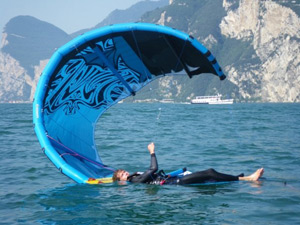
As a beginner, you will practice relaunching your kite from the water a lot. Often, the kite almost wants to fly up by itself, but sometimes it can land in the water in a way that makes it significantly more complicated to get it back up. With the right technique, you will save yourself a lot of frustration (swear words) and get more time for the fun stuff. During the water relaunch phase, you will learn to launch the kite from different positions.
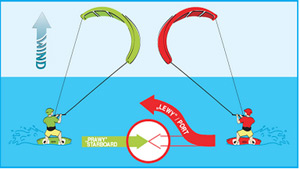
As a kitesurfer, you will soon notice that you are not alone in the water. Fortunately, there are a few simple traffic rules to avoid collisions and ensure that it is safe for everyone to kite. The rules are quite self-explanatory, and once out on the water, you will find that all kiters naturally follow them. Nevertheless, we will go through these right-of-way rules; they are reminiscent of the right-hand traffic rule for cars, just a bit simpler 🙂
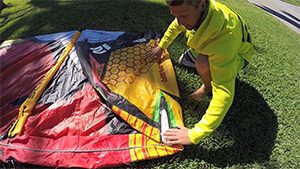
After a completed kite session, there is always the work of packing up the kite equipment. It is somewhat like packing a sleeping bag into a sleeping bag cover. The more careful you are, the easier it becomes to pack everything up. And as with so much other material, you can significantly extend the lifespan of your kite equipment with small, simple measures that we teach during the course.
This is the ultimate course for those who really want to commit to a career as a kitesurfer! This three-day course gives you multiple opportunities to practice the critical maneuvers until they are truly ingrained, and we provide the absolute best conditions for you to be independent after the course. In addition to board starts and other elements in level 1+2, you may get the chance, depending on wishes and how quickly you progress during the course, to also learn maneuvers from level 3, such as jumping, turning, going upwind, etc.
Board start—that is, getting up on the board and gliding across the water. It looks so easy, but in practice it’s a bit more difficult. You need to keep control of the board, the kite, and your body—all at the same time. It’s a bit like learning to ride a bike. You try and try, fall, and have to start over again and again. But sooner or later it clicks, and as instructors we give you the very best conditions for that to happen sooner rather than later 🙂 On the second day of the two-day course, we place a strong focus on the board start.
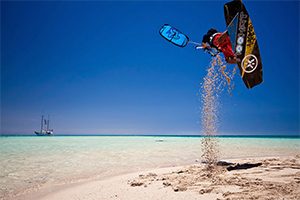
A board start can be performed in many different ways 😉
When learning to kitesurf as a beginner, once you get up on the board and start riding, it’s easy to get so excited that you forget about stopping… More often than not, this ends in an involuntary stop. However, being able to stop when you want to is very important, especially when kiting in a spot with many others in the water. During a three-day course, we ensure you learn to stop in a controlled manner.
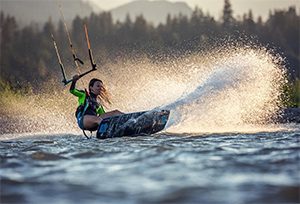
Kite in to the beach, walk 100 meters straight out, kite in to the beach, walk 100 meters straight out… we all know how tiring it can be not being able to go upwind, much like skiing where there is no lift system. However, there are certain tricks for riding upwind in both waves and on flat water. It’s all about finding a balance between body position and kite power, and Gusty would love to teach you!
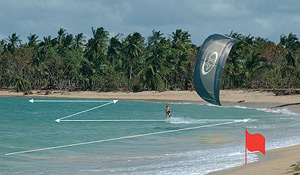
Toeside is a relatively simple trick, although your choice of board can make it a bit tricky. With a little guidance from Gusty, you’ll master this trick in no time—then it’s only a matter of time before you can do a toeside carving turn!
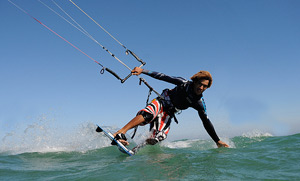
Jumping is an incredible feeling—the higher and longer, the better! The principle is simple: you steer the kite aggressively straight up to the zenith. This maneuver generates a lot of power in the kite and lifts you off the water. But that’s when the tricky part begins—we want to be able to land without getting banged up. With Gusty, you’ll learn the theory behind jumping and the technique to maintain balance in the air and, ultimately, land smoothly on the water.
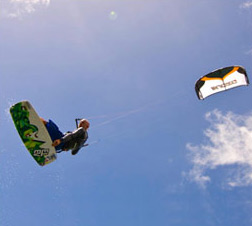
Jump turns, or transitions, can be done in many different ways. The simplest is to make a small jump and change direction, but of course you can add a rotation, a loop, a flip, and more. Gusty will teach you the technique!
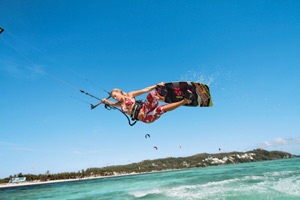
Kiteloop—the ultimate adrenaline rush! Gusty is happy to teach you the technique behind a kiteloop, and of course you can get a demonstration. One requirement, however, is that you can already jump in a controlled way, as this trick is not entirely risk-free. With a helmet and an impact vest, you’re relatively safe if you don’t land the kiteloop. Expect a ride you won’t soon forget 😉
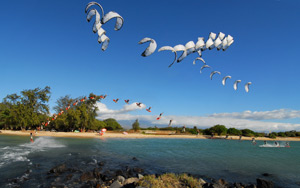
Do you feel like adding an extra day or three with a kite instructor? If you’ve taken our three-day course, you’re welcome to add an unlimited number of extra days.
Do you want to learn how to land a backroll, a transition, or some other cool trick? Or haven’t you kited in two years and feel a bit rusty? With Gusty, you’ll get back on track in no time!
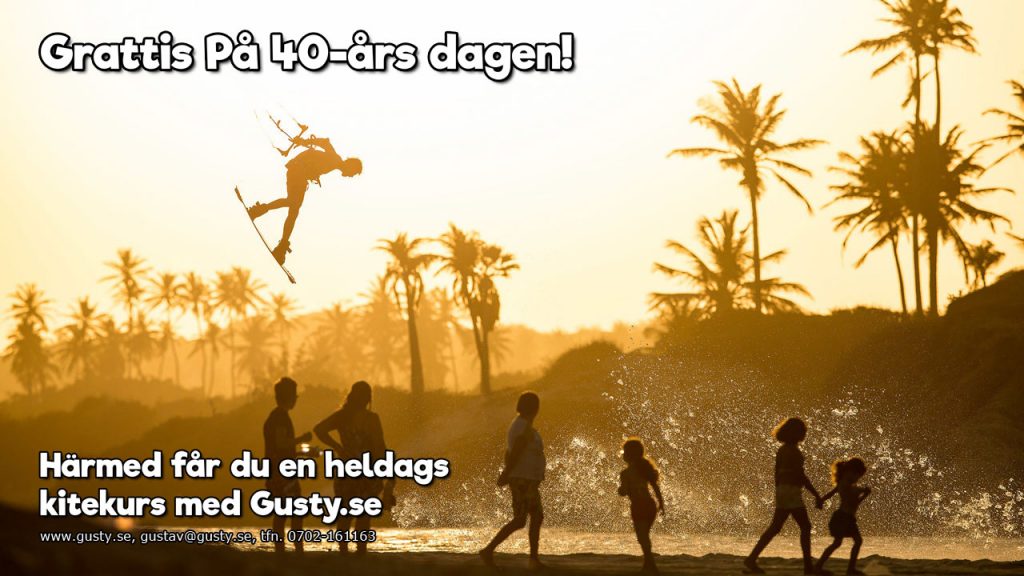
What gift could be better than an exciting, adrenaline-filled experience that could also lead to a new passion in life? Our gift cards are delivered in digital format or, upon request, in postcard format. Both text and images can be customized to your preferences. Here are a few examples.


In the event that you happen to be the only student on one of our day courses, the duration will be shortened by 45 minutes per day. Otherwise, as mentioned, we keep a maximum of two participants per instructor so that you can get the most out of your course with Gusty. Below you can read more about:
Kitesurfing requires wind.
To ensure you have the best possible experience, a certain amount of wind is necessary—at least 4–5 m/s is required to go through the training exercises with a practice kite, and at least 6–7 m/s is preferable when practicing with a full-sized kite in the water.
However, weather forecasts are not always reliable, and if there turns out to be too little wind or it suddenly starts pouring rain, it may be necessary to stop a lesson and continue at a later time when conditions are better. As your instructor, I want you to be satisfied and get the most out of your lesson, which is why any interrupted instruction will of course be continued at another time at no extra cost.
With Gusty, you are in safe hands.
As kite instructors, it is our responsibility to ensure that you do not cause harm to yourself or others, and we of course train you in safe and secure conditions. The equipment used is regularly inspected to ensure that everything is in top condition.
We are all different. Some people learn to kite very quickly, while others take a little longer—but EVERYONE can learn! When we run a kite course, we adapt it to your learning curve so that you can progress safely at your own pace. What is important to us is that, after completing a course, you leave with the knowledge that you have received a solid introduction on how to kitesurf safely and that you will be able to manage on your own.
Weather and wind are two crucial factors in kitesurfing, followed by the location itself, which should be “kite-friendly.” Along the coast of Skåne there are several good spots, and lessons are usually held at Habo Ljung (Lomma) and Lundåkra (south of Landskrona). By agreement, Falsterbo and locations near Båstad, Halmstad, and Varberg can also be used as spots.
All instruction follows the IKO (International Kiteboarding Organization) standards, which means you receive the best and safest training available. After completing the course, you will be registered with the IKO and have the opportunity to leave feedback on the instruction you received through Gusty.

Onwater.se is a surf shop with a wide range of wetsuits, harnesses, kites, boards, spare parts, and more. As a student at Gusty.se, you receive a 10% discount on Onwater’s entire range when shopping at their store in Lund.
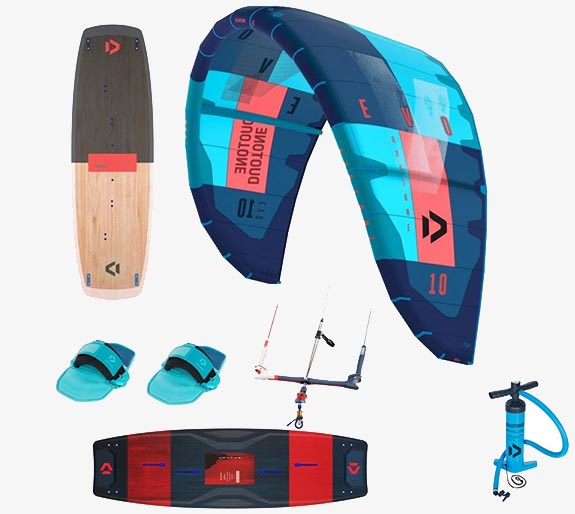
Since kite models and prices change from year to year please contact us and we’ll do our best to setup a good deal for you with surf.se
Still wondering whether kitesurfing is something for you? Of course it is! Do yourself a favour and book a kite course now, we promise you’ll thank yourself afterwards!
PS. We take a maximum of two students per instructor. All equipment is included. You can find more information about our beginner courses here!